7Bit Casino Self-Exclusion
Learn how self-exclusion, time-outs and deposit limits work for 7Bit Casino players in New Zealand, and where to find free support in NZ.
How to close your 7Bit Casino account
To self-exclude from 7Bit Casino, contact the 24/7 live chat, say you want a self-exclusion rather than a normal account closure, and name the length you need. Ask for written confirmation, stop depositing straight away, and call a free NZ service such as the Gambling Helpline if you want support while you take the break.
Closing an account and self-excluding are not the same thing. A closure ends your current account, but nothing in the word itself stops you from coming back later and registering again. Self-exclusion is a deliberate block for a fixed or open-ended period, meant for people who feel play is getting away from them. Decide which one you need before you write to support, because the answer changes what you ask for. If you simply want to stop for a while, a time-out may be enough. If you want to be sure you cannot return on impulse, ask for self-exclusion.
-
1
Decide what you need
Write down whether you want a short break, a closure or a full self-exclusion, and for how long.
-
2
Withdraw your balance
Request a withdrawal of any remaining funds first. Typical timings are on the withdrawal times page.
-
3
Open live chat
Support is available on live chat 24/7, so you can ask at any hour, including late at night when urges tend to be strongest.
-
4
State your request clearly
Use plain words: close my account, or self-exclude me, plus the length of time you want.
-
5
Get it in writing
Ask support to confirm what was set up and the date it starts. Keep that confirmation somewhere safe.
Setting deposit limits before you play
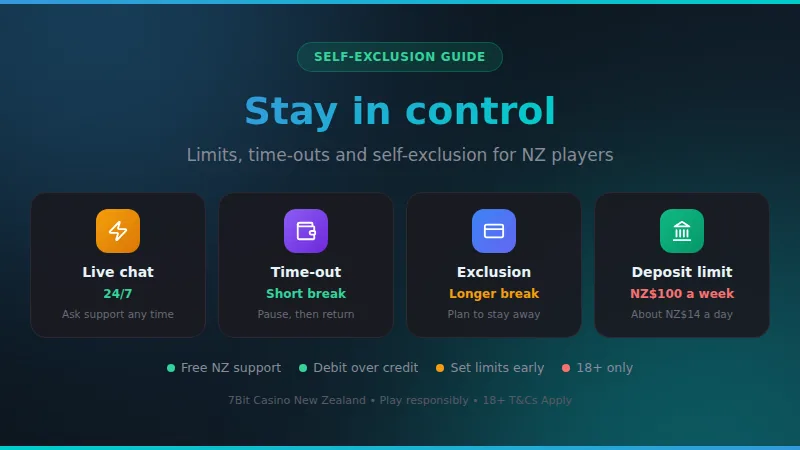
A deposit limit is the simplest tool and the one most worth setting before you play, not after a bad night. The idea is to choose the most you are willing to spend in a week or a month, treat it as the cost of entertainment, and never top up beyond it. Ask live chat which limit options are available on your account and request the lowest figure you are comfortable with. Work from the money left after rent, food and bills, not from what you hope to win.
Enter a weekly budget and see what it means per day and per month, then ask support to set a limit at or below that figure.
| Weekly limit | Daily average | Four weeks |
|---|---|---|
| NZ$50 | about NZ$7 | NZ$200 |
| NZ$100 | about NZ$14 | NZ$400 |
| NZ$200 | about NZ$29 | NZ$800 |
| NZ$300 | about NZ$43 | NZ$1,200 |
Daily figures are the weekly limit divided by seven and rounded. A weekly limit keeps the month predictable: four weeks at NZ$100 is NZ$400, and that is a ceiling, not a target. If your real budget sits below the first row, use it. A smaller number is always fine.
Choose a figure you could lose without touching rent or bills.
Pay by debit card or another method you control. A credit card deposit counts as a cash advance in New Zealand, so keep to debit.
Treat any urge to raise a limit as a decision for tomorrow, not tonight.
Review your limit once a month and lower it if play starts to feel like more than a hobby.
Check the minimum deposit page so your limit sits comfortably above the smallest amount you plan to use, and read the payment methods guide to pick a way of paying that fits your budget.
Taking a time-out
A time-out is a short, temporary pause. It suits the moments when you feel tired, tilted or tempted to chase a loss, but you do not think you need to leave for good. You ask support to lock the account for a set stretch, such as a few days or a few weeks, and when it ends you decide whether to return. Because the break is short, it works best when you pair it with a lower limit for the day you come back.
Cool off after a loss
Step away the same day instead of trying to win the money back. Even a few days resets your head and your budget.
Pick a clear end date
Tell support the exact length you want and ask them to confirm the date when play can resume.
Pair it with a limit
When the break ends, return with a lower weekly limit already in place rather than a promise to be careful.
Use the time well
Remove saved logins, mute promo messages and fill the hours with something else: a walk, sport, time with friends.
A time-out is also a useful test. If you find yourself counting the days until it ends, or wondering how to cut it short, that is a sign to move on to self-exclusion, which is built for exactly that situation.
Self-exclusion explained
Self-exclusion is a longer block, usually measured in months or years, during which you cannot play. The point is that it is hard to undo on impulse. Ask support to apply it to your account, state the period you want, and ask that marketing messages stop as well. Once it is active, do not try to open another account or find a way around it. That defeats the purpose and keeps the habit alive.
Strengths
- Removes the temptation of quick deposits
- Gives you a clear start date and a clear end date
- Lets you rebuild routines without pressure
- Gives many people real relief within the first weeks
Worth knowing
- Cannot be cut short on a whim
- You need to start it yourself through support
- Other sites or betting accounts need separate requests
- Withdraw the balance you have left.
- Ask support for written confirmation of the exclusion and its dates.
- Unsubscribe from promo emails, texts and push alerts.
- Remove saved cards and wallets from your browser and phone.
- Tell someone you trust, and consider calling a free support service.
Self-exclusion with one site does not carry over to others. If you also play at other online sites or hold betting accounts, contact each one separately so the break is complete.
What players say about taking a break
Players who have used breaks tend to describe the same pattern. Many say that round-the-clock live chat made it easy to ask for a pause without waiting for office hours, and that the conversation was short and polite. Others say the hardest part was deciding, not the process, and that a written confirmation gave them peace of mind. A common piece of advice is to ask early, before a losing run, and to combine a limit with a time-out rather than relying on willpower alone.
Where to get help in New Zealand
If gambling is causing stress, you do not have to handle it alone. In New Zealand the Gambling Helpline offers free, confidential support, and pgf.nz, the website of the Problem Gambling Foundation, has information, tools and ways to get in touch. Talking to someone outside the situation often makes the next step clearer, whether that is a limit, a time-out or a long exclusion.
- You spend more than you planned, or more than you can afford.
- You chase losses or play to escape stress.
- You hide play from family or friends.
- You borrow money or skip bills to keep playing.
- You feel anxious or irritable when you are not playing.
- Live chat
- 24/7
- Free NZ helpline
- Gambling Helpline
- Online resource
- pgf.nz
- Minimum age
- 18+
For other account questions, see the FAQ and the 7Bit Casino overview. You can also read how we write our guides in the editorial policy. If you are ever unsure which step to take first, start with a low deposit limit and a short time-out, then review honestly how you feel once the break ends.
Self-exclusion questions answered
How do I self-exclude from 7Bit Casino?
What is the difference between a time-out and self-exclusion?
Can I set a deposit limit at 7Bit Casino?
Should I withdraw my balance before I self-exclude?
Does self-exclusion at 7Bit Casino cover other sites?
Where can I get free support in New Zealand?
Keep reading
Ready to see it for yourself?
Open the cashier, check the limits that apply to your account and decide from there.
18+ | T&Cs apply | Gambling Helpline NZ